A smooth medical billing process is the backbone of financial stability in any healthcare practice. When billing is accurate, timely, and efficient, practices see faster reimbursements, reduced denials, and a steady cash flow. On the other hand, small errors or delays can create serious revenue gaps, affecting the ability to invest in staff, technology, and patient care. By improving medical billing workflows and adopting proven strategies, practices can strengthen their revenue cycle and maintain consistent growth.
Table of contents
Why Efficient Medical Billing Matters
An efficient medical billing process ensures that healthcare providers are paid accurately and on time for the services they deliver. Every denied or delayed claim directly impacts practice revenue, with studies showing that 5–10% of revenue may be lost due to preventable billing errors.
When claims move smoothly through the revenue cycle, practices benefit from:
- Stronger cash flow that supports operational costs and growth.
- Reduced administrative burden on staff who would otherwise chase unpaid claims.
- Improved patient satisfaction, since clear billing reduces confusion and payment delays.
For providers who want to build a stronger revenue cycle, our Revenue Cycle Management services offer the structure and support needed to minimize financial leakage and keep payments consistent.
Common Challenges in the Medical Billing Process
Even the most experienced practices face challenges that disrupt billing workflows and cash flow. Understanding these obstacles is the first step toward fixing them.
Coding Errors and Documentation Gaps
Incorrect or incomplete coding is one of the leading causes of claim denials. Small mistakes in CPT or ICD codes, missing modifiers, or insufficient documentation can result in payers rejecting claims. Beyond revenue loss, frequent errors also slow down reimbursement and add extra workload for staff. Partnering with expert coders and maintaining updated knowledge of payer rules can reduce these costly issues.
Delayed Claim Submissions
Timely filing is critical in medical billing. Missing payer deadlines, even by a few days, often leads to claim rejections that cannot be appealed. Many practices struggle with delayed submissions due to staff shortages or manual processes. Implementing automated claim submission systems and tracking tools ensures claims are sent within deadlines, reducing the risk of revenue leakage.
Patient Payment Collections
Patient responsibility is growing as high-deductible health plans become more common. Practices often face challenges when patients delay payments or do not understand their bills. Lack of clear communication, insufficient follow-up, and weak financial counseling can slow down collections. Educating patients about their financial responsibilities and offering multiple payment options improves collection rates and reduces bad debt.
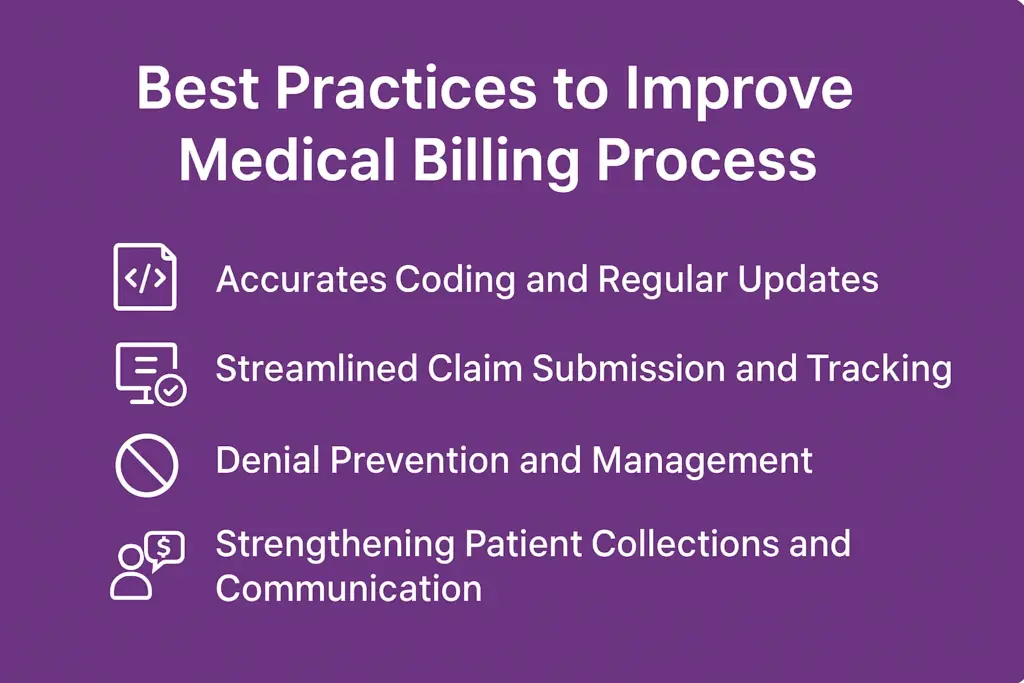
Best Practices to Improve Medical Billing Process
Adopt these best practices to reduce denials, speed reimbursements, and strengthen your cash flow.
Accurate coding and regular updates
Accurate coding prevents many common denials. Run regular coding audits and update staff on ICD-10 and CPT changes. Use certified coders for complex cases and schedule periodic chart reviews. For help, see our Medical Coding Services.
Streamlined claim submission and tracking
Submit claims electronically and use a clearinghouse to catch errors before they reach payers. Implement claim-scrubbing tools that flag missing modifiers, mismatched codes, and duplicate claims. Automated tracking lets you see claim status in real time and act quickly when issues arise. If you need technical support, our Tech Services can help with integrations and automation.
Denial prevention and management
Prevent denials by validating eligibility, confirming authorizations, and ensuring documentation supports medical necessity. When denials occur, perform root-cause analysis and update workflows to stop repeats. For a step-by-step approach, refer to our guide on Denial Management.
Strengthening patient collections and communication
Communicate patient financial responsibility clearly at scheduling and check-in. Offer online payment options, flexible plans, and friendly reminders to improve point-of-service collections. Train front desk staff to estimate out-of-pocket costs accurately. See how our Front Desk Support Services can boost collections and reduce patient confusion.
Leveraging Technology for Billing Efficiency
Modern technology plays a vital role in reducing errors, speeding up payments, and simplifying workflows in medical billing.
Claim scrubbing software catches coding mistakes before claims go out, cutting down denials. EHR integration ensures seamless data flow between clinical and billing teams, improving documentation accuracy. Real-time eligibility checks confirm coverage instantly, avoiding costly claim rejections. Practices that invest in digital tools see faster reimbursements and lower administrative burdens.
According to CMS guidance, using electronic health records and automated claim systems not only improves compliance but also significantly reduces administrative waste in the billing cycle.
| Technology Tool | Key Benefit |
|---|---|
| Claim Scrubbing Software | Reduces errors and lowers denial rates |
| EHR Integration | Improves documentation accuracy |
| Real-Time Eligibility Checks | Prevents rejections and speeds payments |
| Automated Claim Tracking | Provides instant claim status updates |
Partnering With Experts for Improved Cash Flow
While technology and internal processes help, many practices see the greatest improvement in cash flow when they partner with experienced billing professionals. Outsourcing medical billing brings specialized knowledge, advanced tools, and dedicated teams that consistently reduce errors and denials.
Key benefits include:
- Faster claim submissions with fewer rejections.
- Reduced days in accounts receivable (AR).
- Consistent follow-up on unpaid claims.
- More time for staff to focus on patient care instead of administrative tasks.
By working with experts, practices achieve smoother revenue cycles and long-term financial stability. To see how this works in practice, you can talk to a Medical Billing Expert today.
Case Example of Improved Cash Flow Through Better Billing
A mid-sized primary care clinic was struggling with delayed reimbursements and a denial rate above 12%. Their internal staff was overwhelmed, causing claims to pile up and patients to face billing confusion.
After partnering with a professional billing team, the clinic implemented real-time eligibility checks, automated claim scrubbing, and consistent follow-up on outstanding accounts. Within six months:
- Denial rate dropped to below 5%.
- Average AR days reduced from 45 to 25.
- Monthly cash flow increased by 22%.
This shift not only stabilized the clinic’s finances but also freed up staff to focus on improving patient experience.
Conclusion
Improving the medical billing process is one of the most effective ways for practices to secure steady revenue and avoid financial bottlenecks. From accurate coding and timely submissions to leveraging technology and outsourcing, each strategy directly strengthens cash flow.
With proper denial management and patient-friendly collection practices, providers can minimize revenue leakage and create a more sustainable financial future. Investing in efficient medical billing services ensures practices stay profitable while maintaining focus on patient care.
Frequently Asked Questions
The leading cause is delayed or denied claims, often due to coding errors, incomplete documentation, or missed filing deadlines.
Yes. Outsourcing to experts reduces errors, shortens AR days, and improves first-pass resolution rates, which directly enhances revenue flow.
Tools like claim scrubbing software, EHR integration, and real-time eligibility verification catch errors before submission, lowering denial rates.
Important metrics include denial rate percentage, days in accounts receivable (AR), first-pass resolution rate, and overall monthly cash flow.