Medical coding is the foundation of accurate billing and timely reimbursements, but coding rules can vary widely depending on whether care is provided in an outpatient or inpatient setting. Misunderstanding these differences can lead to claim denials, delayed payments, and compliance risks that impact your practice’s revenue.
In this guide, we break down the key distinctions between outpatient and inpatient coding, explain how each affects documentation and billing, and provide practical insights to help healthcare providers optimize their revenue cycle and stay compliant with payer requirements.
Table of contents
- What Is Medical Coding in Outpatient and Inpatient Settings?
- Key Differences Between Outpatient vs Inpatient Coding
- Why Understanding the Differences Matters for Healthcare Providers
- Common Challenges in Outpatient vs Inpatient Coding
- Best Practices to Master Outpatient and Inpatient Coding
- When to Outsource Coding for Outpatient and Inpatient Services
- Conclusion
- FAQs
What Is Medical Coding in Outpatient and Inpatient Settings?
Medical coding is the process of translating clinical services, procedures, and diagnoses into standardized codes that payers use to process claims. While the goal of coding is the same across all settings to ensure accurate reimbursement, coding practices differ between outpatient and inpatient care due to variations in documentation, billing rules, and payer requirements. Understanding these differences is crucial for accurate claim submission, compliance, and efficient revenue cycle management.
Overview of Outpatient Coding
Outpatient coding applies to services where patients do not stay overnight in a healthcare facility, such as clinic visits, diagnostic tests, or same-day procedures. Coders primarily use CPT (Current Procedural Terminology) and HCPCS codes to document procedures, along with ICD-10 codes for diagnoses. Outpatient coding often emphasizes efficiency, accuracy, and first-pass claim acceptance, as claims are generally processed faster and follow stricter payer guidelines for same-day services.
Overview of Inpatient Coding
Inpatient coding is used for services provided to patients admitted to a hospital or healthcare facility for one or more nights. It involves more detailed documentation, as coders need to capture comorbidities, complications, procedures, and length of stay.
Inpatient coding typically relies on ICD-10-CM codes for diagnoses and ICD-10-PCS codes for procedures, and often requires comprehensive chart reviews to support complex claims. Accurate inpatient coding is critical to avoid denials, audits, and delayed reimbursements due to the complexity of hospital stays.
Key Differences Between Outpatient vs Inpatient Coding
Here’s a clear comparison of outpatient and inpatient coding practices for easy understanding:
| Feature | Outpatient Coding | Inpatient Coding |
|---|---|---|
| Setting | Clinics, urgent care, same-day procedures | Hospital admissions, overnight stays |
| Coding Systems | CPT, HCPCS, ICD-10-CM | ICD-10-CM, ICD-10-PCS |
| Documentation Focus | Procedure performed, diagnosis, modifiers | Full hospital stay, procedures, comorbidities, complications |
| Claim Complexity | Relatively simpler, faster claim processing | Complex, higher scrutiny by payers |
| Revenue Cycle Impact | Quick reimbursements if coded correctly | Longer billing cycles, risk of delays if errors occur |
| Compliance Risk | Moderate, mostly related to procedure coding | Higher, audits are more frequent due to inpatient complexity |
Why Understanding the Differences Matters for Healthcare Providers
Healthcare providers must understand the distinctions between outpatient and inpatient coding to ensure accurate claims, timely reimbursements, and compliance. A thorough understanding helps practices optimize their revenue cycle while reducing administrative burdens.
Accurate Reimbursements and Reduced Denials
Correctly classifying services as outpatient or inpatient ensures that claims are coded and submitted according to payer rules. Accurate Medical coding reduces denials, accelerates reimbursement, and prevents revenue loss caused by rejected claims or improper billing.
Compliance With Payer and Regulatory Rules
Payers and regulatory agencies have different requirements for inpatient versus outpatient services. Understanding these rules helps practices avoid audits, fines, or penalties by ensuring that coding, documentation, and claims submission meet compliance standards.
Impact on Revenue Cycle Management
Accurate coding directly affects the efficiency of the revenue cycle. Misclassifying services or using incorrect codes can slow down claims processing, increase administrative work, and create unpredictable cash flow. Knowledge of the differences allows practices to streamline workflows and maintain financial stability.
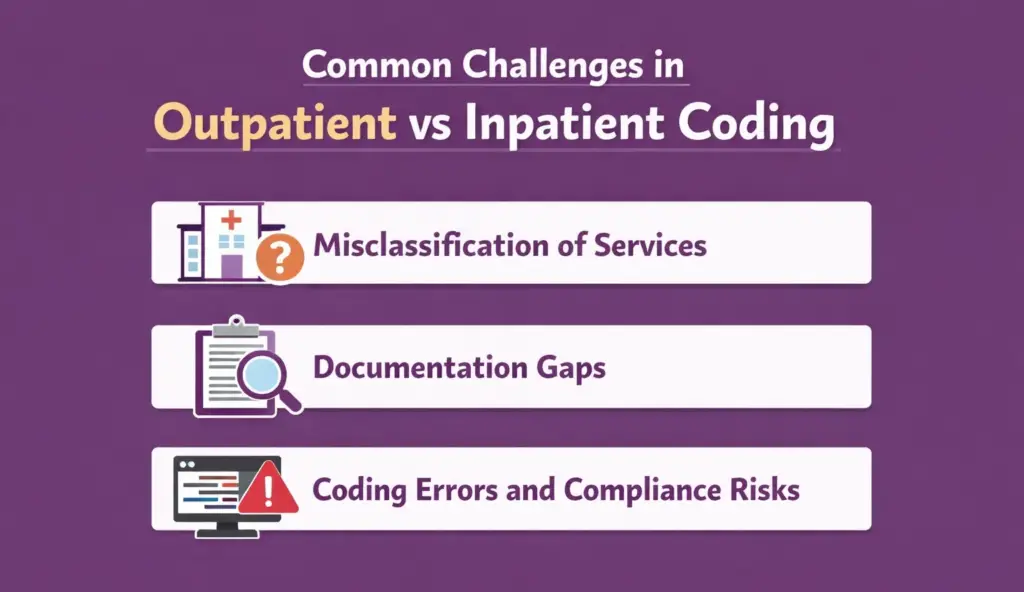
Common Challenges in Outpatient vs Inpatient Coding
Even experienced coding teams face obstacles when managing both outpatient and inpatient claims. Awareness of these challenges allows practices to implement strategies that prevent errors and optimize billing efficiency.
Misclassification of Services
One of the most common issues is incorrectly identifying whether a patient encounter should be billed as outpatient or inpatient. Misclassification can lead to claim rejections, underpayment, or overpayment and can trigger audits from payers.
Documentation Gaps
Incomplete or inconsistent documentation is a frequent barrier. Outpatient visits may lack sufficient detail for CPT or HCPCS coding, while inpatient records require comprehensive documentation of procedures, comorbidities, and complications. Missing information increases the risk of denials.
Coding Errors and Compliance Risks
Errors such as using outdated codes, missing modifiers, or incorrect ICD-10/PCS assignments can lead to delayed payments and compliance issues. Inpatient coding is particularly susceptible to errors due to the complexity of hospital stays, which can also result in financial penalties if audits uncover mistakes.
Best Practices to Master Outpatient and Inpatient Coding
Mastering coding for both outpatient and inpatient services requires consistent attention, training, and the right tools. Implementing best practices ensures accuracy, reduces claim denials, and supports smooth revenue cycle management.
Regular Training and Certification
Coders should complete ongoing training and maintain certifications to stay up to date with the latest coding standards, including ICD-10, CPT, and HCPCS. Regular training improves accuracy and ensures compliance with payer and regulatory requirements.
Conduct Coding Audits
Routine coding audits identify errors, inconsistencies, and trends that can negatively impact claims. Audits help refine workflows, prevent repetitive mistakes, and ensure both outpatient and inpatient claims meet payer standards.
Maintain Updated Payer Guidelines
Payers frequently update coding rules, documentation requirements, and claim submission procedures. Staying informed of these updates helps practices submit clean claims and avoid unnecessary denials or delays.
Use Technology and Coding Software
Advanced coding software and technology tools streamline the coding process, reduce manual errors, and help track compliance. Automated systems support faster claim submission, first-pass acceptance, and consistent documentation for both outpatient and inpatient services.
When to Outsource Coding for Outpatient and Inpatient Services
Outsourcing coding can be a strategic solution for practices seeking to improve accuracy, reduce administrative burdens, and increase revenue. Consider outsourcing when your practice experiences:
- High claim denial rates due to coding errors
- Lack of certified in-house coders or frequent staff turnover
- Rapid growth or increasing patient volumes
- Frequent changes in payer rules or complex documentation requirements
- Need for consistent compliance with audits and regulatory standards
Conclusion
Understanding the differences between outpatient and inpatient coding is critical for healthcare providers to ensure accurate claim submission, timely reimbursements, and regulatory compliance. Misclassifying services or making coding errors can lead to denied claims, delayed payments, and increased audit risk. By implementing best practices such as regular training, coding audits, updated payer guidelines, and leveraging technology, practices can streamline their revenue cycle and protect their bottom line.
FAQs
Outpatient coding applies to same-day procedures and clinic visits using CPT, HCPCS, and ICD-10-CM codes, while inpatient coding covers hospital stays using ICD-10-CM and ICD-10-PCS codes with detailed documentation.
Inpatient coding is more complex because it requires comprehensive documentation of procedures, comorbidities, complications, and length of stay, making claims more detailed and time-intensive.
Yes, but it requires specialized training and experience, as each setting has unique rules, documentation standards, and payer requirements.
Outsourcing is ideal when practices face high denial rates, staff shortages, rapid growth, frequent payer updates, or need consistent compliance support for both outpatient and inpatient claims.