You open a remittance and one line says CO 206. Another says N381. A third says CO 24. The payment is zero or short, and the note beside it does not tell you much.
These three codes come up in search all the time, so here is what each one means, why it happens and what your billing team can do about it. First, a short look at how these codes are put together, because that explains most of the confusion.
Quick answers
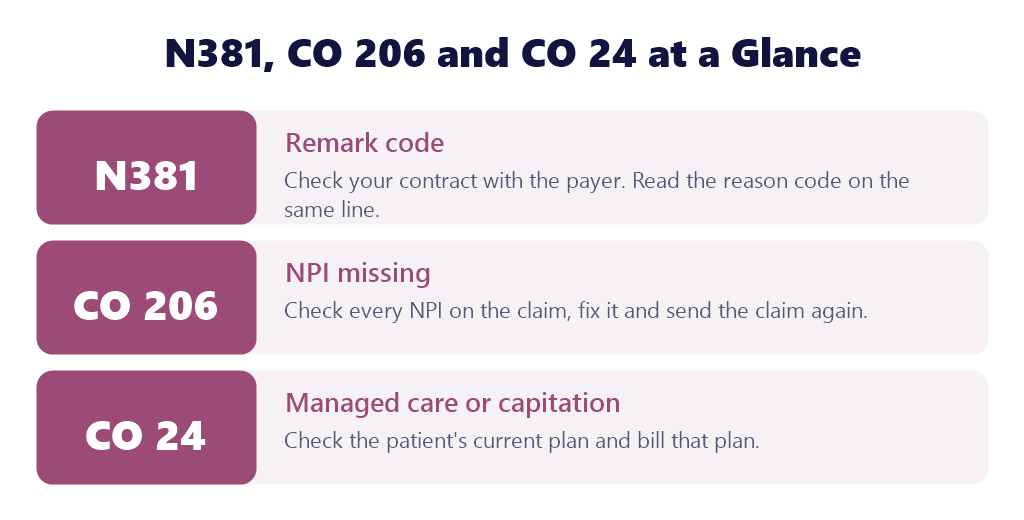
- N381: a remark code that tells you to check your contract with the payer for the rules on those charges. On its own it does not deny anything. Look at the reason code on the same line.
- CO 206: the reason code for a missing National Provider Identifier (NPI). Check every NPI on the claim and send it again.
- CO 24: the charges are covered under a capitation or managed care plan. Check which plan the patient really has and bill that plan.
How to read these codes
A line on a remittance can carry up to three parts.
- The group code says who is responsible for the amount. CO means contractual obligation: the provider absorbs it and generally cannot bill the patient. PR means patient responsibility, such as a deductible, copay or coinsurance. OA means other adjustment, used when neither of those fits. PI means the payer reduced the payment under its own policy.
- The reason code is a number that explains the adjustment. It is called a claim adjustment reason code, or CARC. The 206 in CO 206 and the 24 in CO 24 are reason codes.
- The remark code adds detail. It is called a remittance advice remark code, or RARC. N381 is one of these.
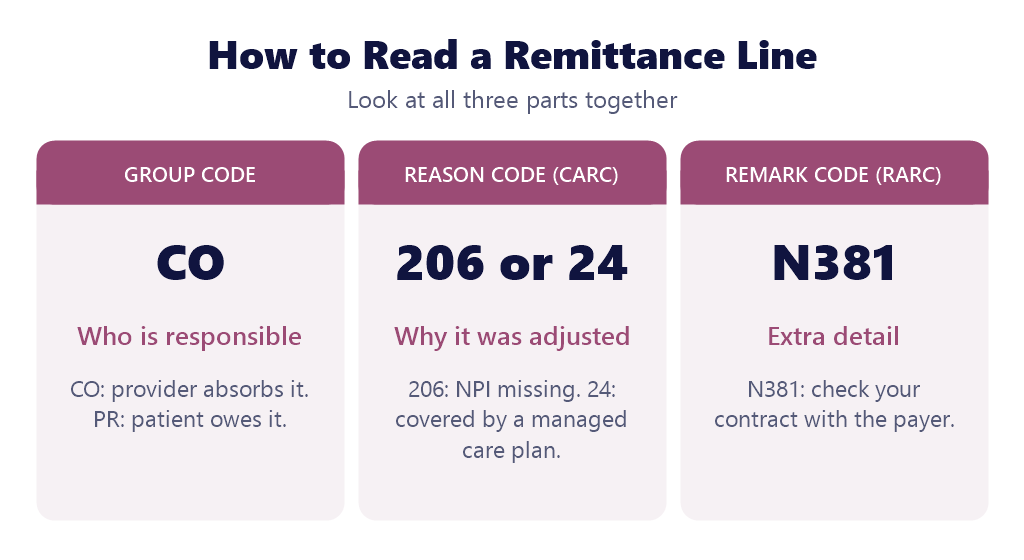
The same reason number can mean something different with a different group code. CO 206 and PR 206 look alike, but only one of them can be billed to the patient. Always read all the parts together.
N381 denial code
People search for N381 as a denial code, but strictly it is a remark code. It is an alert that tells you to consult your contractual agreement with the payer for restrictions, billing or payment information about those charges. It does not decide whether the claim is paid. The reason code and group code beside it do that.
Why it shows up
- The service is not covered, or has restrictions, under your contract with that payer.
- The payer applied a billing or payment rule from the contract to that line.
- The contract information you have is out of date, so the payment looks wrong to your team.
What to do
- Read the reason code and group code on the same line. They tell you what actually happened to the money.
- Open your contract or fee schedule for that payer and find the service.
- If the contract allows payment, call the payer with the claim number and ask which rule they applied. If they got it wrong, send a corrected claim or file an appeal.
- If the contract excludes or limits the service, adjust the balance the way the group code says. With CO, you generally cannot bill the patient for it.
How to prevent it
Keep a short summary of each payer contract where billing staff can reach it, and update it when the contract changes.
CO 206 denial code
The official description of reason code 206 is that the National Provider Identifier is missing. The NPI is the 10 digit number that identifies a provider. A claim can need one for the billing provider, the rendering provider, and in some cases the referring or ordering provider.
Why it happens
- An NPI was left off the claim, or typed wrongly.
- The NPI on the claim does not match the one in the provider’s record.
- A new provider started and the practice management system was never updated.
Some payers also use this code when they do not recognize the NPI. If that is what your payer means, you will usually see it in their remittance guide or in the remark codes, so read those before you act.
What to do
- Find which provider the claim line needs an NPI for. Check the billing, rendering, referring and ordering fields.
- Compare each NPI with the provider’s record in the national NPI registry (NPPES).
- Check that the provider is enrolled with this payer under that NPI.
- Correct the claim and send it again. Do not write it off until you have checked, because the fix is usually small.
How to prevent it
Keep one table of every provider with their NPI and payer enrollment status, and update it the day someone joins or leaves.
CO 24 denial code
Reason code 24 means the charges are covered under a capitation agreement or managed care plan. In plain words, the patient is in a plan that pays a set amount to another organization to cover their care, so the payer you billed is not the one to pay for this service.
A common case: a claim goes to Original Medicare for a patient who is actually enrolled in a Medicare Advantage plan. Medicare returns it with this code and the claim should go to the plan instead.
Why it happens
- The patient changed plans and the information on file is old.
- The patient has more than one plan and the claim went to the wrong one first.
- The service is covered by a capitation arrangement your practice is part of.
What to do
- Check the patient’s current coverage and who the plan is.
- If the patient is in a managed care plan, send the claim to that plan.
- If your practice is paid under a capitation agreement for this service, there is usually nothing more to collect for it. Post the adjustment the way your agreement says.
- If the patient is not in any such plan, call the payer and ask them to correct it.
How to prevent it
Check coverage before every visit. Our insurance eligibility verification checklist shows what to check and when. It also catches a second plan, which is a common reason for CO 24.
Habits that prevent all three
- Check eligibility before each visit, not just at the first one.
- Keep a provider table with NPIs and payer enrollment.
- Keep contract summaries where billing staff can reach them.
- Read remittances every week and note which codes repeat. A code that shows up again and again points to a process problem, not bad luck.
- Look up any unfamiliar code in our full list of denial codes.
Common questions
Is N381 a denial code?
Not exactly. It is a remark code that adds information to a line. The denial or adjustment itself comes from the reason code and group code next to it.
Can I bill the patient for a CO adjustment?
Generally no. CO means contractual obligation, so the provider absorbs it. Amounts marked PR are the ones that can be billed to the patient. Check your payer contract if you are unsure.
Where can I find the official meaning of a code?
The official code lists are maintained by X12, and each payer publishes its own remittance guide. Descriptions get updated, so check the current wording there before you rely on one from memory.
Do all payers use these codes the same way?
Mostly, but not always. Some payers use a code a little more broadly than its official description. When a payer’s use looks different, call them and ask.
If the same codes keep coming back on your remittances, it is worth finding out why. Our free audit page is a good place to start. We review your claims and show where payments are held up.