Your biller gives notice. Or denials pile up while your front desk covers the phones. Or a new provider joins and claims double overnight. This is usually the moment a practice starts asking whether it should keep billing in house or hand it to an outside company.
There is no answer that fits every practice. This guide lays out what each option really involves, when each one makes sense, what the risks are and how to switch if you decide to. It ends with a short scorecard you can run in five minutes.
The short answer
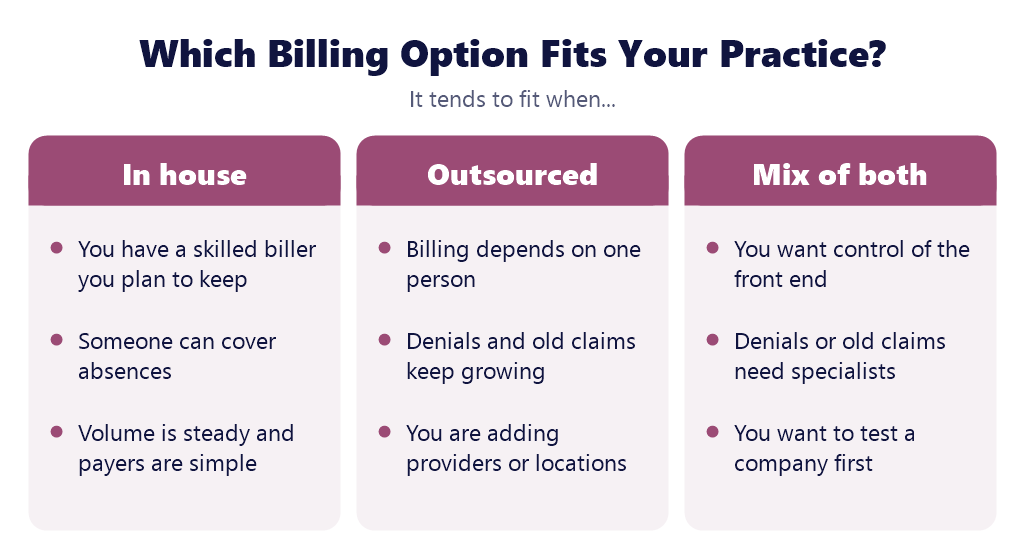
- In house tends to fit when you have a steady volume, an experienced biller and a backup person who can cover absences.
- Outsourced tends to fit when billing depends on one person, denials and old claims keep building up, or you are growing and do not want to hire and train again.
- A mix of both works for many practices: you keep the front end in house and outsource the hard parts.
What each option really means
| In house | Outsourced | Mix of both | |
|---|---|---|---|
| Who does the work | Your own employees | An outside billing company | Both, with a clear split |
| Control | Most direct | Shared, through reports and agreements | Shared |
| When someone is out | Work waits, or someone fills in | The company has other staff | Depends on the split |
| Cost pattern | Salary, benefits, software, training | Usually a percentage of collections or a fee per claim | Both, in smaller amounts |
| Knowledge of payer rules | Depends on one or two people | A team that sees many payers | Shared |
| Reporting | Whatever you build | Whatever the contract provides | Depends |
| Effort to set up | Hiring and training | Choosing a company and onboarding | Defining the split |
For the price side, our guide on how much medical billing companies charge explains the common fee models and the extra costs to ask about.
When in house makes sense
- You have a skilled biller or coder you trust and plan to keep.
- You have someone who can step in when that person is on vacation or sick.
- Your claim volume is steady and your payer mix is simple.
- You want every claim handled by people who sit in your building.
- You already have good reporting and review your numbers every month.
When outsourcing makes sense
- Billing sits on one person. If that person leaves, your cash flow stops with them.
- Denials and old claims keep growing. Nobody has time to work them before deadlines pass.
- You are adding providers or locations. Hiring, training and covering absences gets harder as you grow.
- Your front desk is doing billing on the side. Check in and phones always win.
- You have no clear reports. You cannot say how many claims were denied last month or how old your unpaid claims are.
- Payer rules are changing faster than you can follow them.
The middle option
Outsourcing does not have to be all or nothing. Many practices keep scheduling, check in and patient questions in house and hand over the parts that take the most specialist time. Common splits are:
- Denial management and appeals only.
- Old unpaid claims only, as a one time cleanup.
- Credentialing and payer enrollment.
- Full billing from claim to payment.
Starting with one piece lets you see how a company works before you hand over more.
The risks of outsourcing, and how to cover them
Outsourcing is not risk free, and a good decision accounts for that.
- You lose day to day visibility. Ask for regular reports on claims sent, paid, denied and unpaid, and read them.
- The company may not fit your specialty. Ask for experience with your type of practice and your main payers.
- Patient data leaves your office. Under HIPAA, a covered practice needs a written business associate agreement with a billing company before sharing patient information. Do not start without one.
- Money has to go to the right place. Medicare pays in the provider’s name, so make sure payments land in a bank account you control, not the billing company’s. Check current Medicare rules for how this works for your practice.
- Getting out can be hard. Read the notice period and what happens to open claims if you leave.
A five minute scorecard
Answer yes or no for your practice:
- Does billing depend on one person?
- Have you had unpaid claims go past a payer’s deadline in the last year?
- Do you struggle to say how many claims were denied last month?
- Are you planning to add a provider, a location or a new service?
- Does your front desk handle billing along with other work?
- Has it been hard to hire or keep a biller?
- Are your unpaid claims older than 90 days a growing share of your total?
- Do payer rule changes catch you off guard?
This is a rough guide, not a rule. If you answered yes to only one or two, in house may be working fine. If you answered yes to most of them, it is worth getting a quote or an audit.
What switching looks like
Moving billing to an outside company goes smoothly when you prepare for it.
- Pull your reports. Aging report, recent remittances, a list of payers and your fee schedules.
- Clean up what you can. Note which old claims are still open.
- Sign the agreements. This includes the business associate agreement and the service contract.
- Set up access. Agree which systems and reports the company needs and who can see what.
- Check enrollment. Make sure your providers are enrolled with each payer and that payments go to your own account.
- Overlap for a short period. Keep your own person involved while the company takes over, so nothing is dropped.
- Review the first month together. Look at claims sent, paid and denied, and fix problems early.
Our medical billing services page shows what we handle if you decide to hand billing over.
Common questions
Is outsourcing medical billing cheaper than in house?
Not always. In house costs show up as salaries, benefits, software and training. Outsourcing shows up as fees. The better comparison is what you collect and keep after all costs, not the headline price.
Will I lose control of my billing?
You give up the daily tasks, not the decisions. You still set policies, approve write offs and see the reports. Choose a company that is open about its work and gives you regular access to your numbers.
Do I need a business associate agreement?
Yes. HHS says a covered practice must have written assurances, usually a contract, that a business associate will protect patient information. A billing company is generally a business associate.
Can I outsource only part of my billing?
Yes. Many practices outsource only denials, old claims or credentialing. It is a good way to try a company before handing over more.
How do I switch without disrupting cash flow?
Prepare your reports, keep your own person involved for a short overlap and review the first month together. Most problems come from missing information at the start, so get that ready first.
If you want a second opinion on where your claims are getting stuck, our free audit page is a good place to start. We review your claims and show where payments are held up.