If you are asking what a medical billing company costs, you have probably already noticed that nobody gives you a straight number. One quote says 5%. Another says $4 a claim. A third wants a monthly fee plus a setup charge.
They are not as different as they look. This guide explains how medical billing companies set their prices, what the usual ranges are, which extra fees to ask about and how to compare two quotes so you are really comparing the same thing.
The short answer
Most billing companies charge a percentage of what they collect for you. Pricing guides from billing companies commonly quote between 4% and 10% of collections, and many quotes for small and mid sized practices fall somewhere around 5% to 8%. Per claim pricing is usually quoted at about $3 to $10 a claim.
Treat these as ballpark figures. Nearly all of the published numbers come from billing companies and software vendors, not from independent studies, and your own quote will depend on your specialty, your volume and what the company does for the money.
The four ways billing companies price their work
| Pricing model | How it works | Suits | Watch out for |
|---|---|---|---|
| Percentage of collections | A set percent of the payments collected | Most practices | Make sure it is based on money collected, not on amounts billed |
| Per claim | A fixed fee for each claim submitted | Practices with steady, predictable volume | Fees can climb when you send many small claims |
| Flat monthly fee | One fixed amount each month | Larger or very steady practices | The fee may not shift if your volume falls |
| Hourly | Pay for the time spent | Specific projects, such as clearing old claims | Hard to budget, and the hours are hard to check |
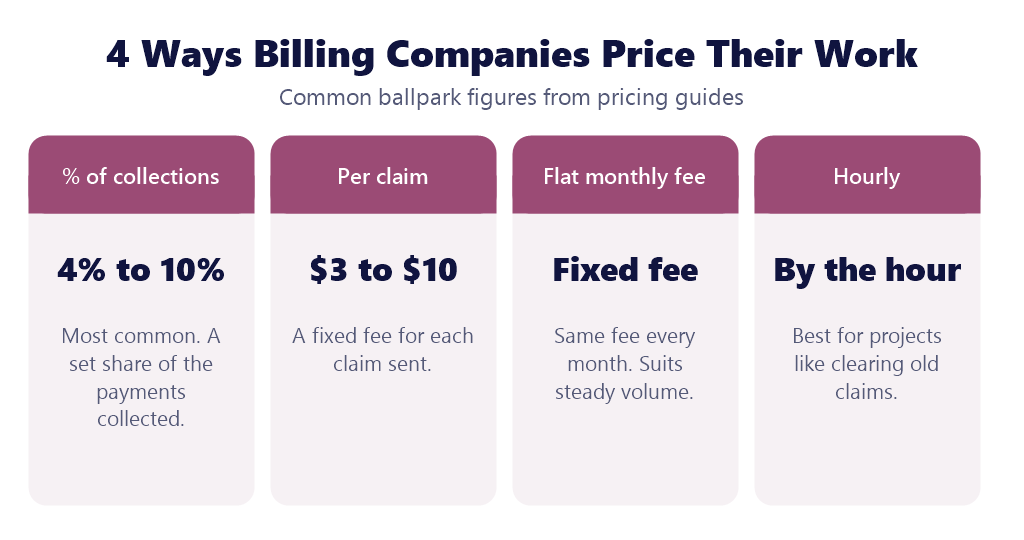
The percentage model is the most common because the billing company only earns when you do. That lines up your interests. It also means a company with a very low rate may have little reason to chase hard claims, so the rate alone does not tell you how well your money will be collected.
What the numbers look like
A quick example shows why the headline rate is only part of the picture. These figures are made up to show the arithmetic.
Say your practice collects $60,000 in a month.
- At 6%, the monthly fee is $3,600.
- At 8%, the monthly fee is $4,800.
- With a per claim fee of $5 on 800 claims, the monthly fee is $4,000.
To compare any quote, work out the effective rate: total fees paid divided by total money collected. If you pay $4,000 on $60,000 collected, your effective rate is about 6.7%, even if the quote said “$5 per claim.”
What makes the price go up or down
- Specialty. Fields with complex coding, authorizations or modifiers usually cost more to bill than simple primary care visits.
- Volume. Practices with more claims and more collections often get a lower rate.
- Payer mix. A practice that depends on Medicare, Medicaid and many commercial plans creates more work than one with a few payers.
- Condition of your accounts. If you have a backlog of old unpaid claims, expect that cleanup to be priced on its own or at a higher rate.
- What is included. Some companies bill only. Others also handle coding, credentialing, prior authorization and patient statements.
Extra costs to ask about
The quoted percentage is rarely the whole bill. Ask about each of these before you sign:
- Setup or onboarding fees. Some companies charge for getting your account started.
- Monthly minimums. A small practice can end up paying more than the percentage suggests if there is a minimum fee.
- Clearinghouse charges. Some companies pass these on to you.
- Credentialing and payer enrollment. Often priced separately from billing.
- Patient statements and postage. Check whether they are included.
- Ending the contract. Ask about notice periods and what you pay for claims still being worked after you leave.
What it costs to do billing in house
Billing in house is not free just because there is no invoice. The U.S. Bureau of Labor Statistics reports a median annual wage of $47,170 for billing and posting clerks as of May 2024. That is the wage alone, before benefits, payroll taxes, software, training and the cost of covering sick days and vacations. It also does not include the cost of mistakes, such as claims that go out wrong or deadlines that pass.
The cost question is really about what you get for the money. A person who handles billing along with phones and check in often has no time to chase denials. A dedicated team can follow up on denials and deadlines that a busy front desk rarely reaches. Our medical billing services and wider revenue cycle management services cover the whole cycle if you decide to hand it over.
Why the cheapest quote is not always the cheapest
A 4% company that collects less than a 6% company can cost you more in the end. Imagine one company collects $50,000 a month for you and charges 4%, which is $2,000. Another collects $58,000 and charges 6%, which is $3,480. You pay more to the second company, but you keep $54,520 compared with $48,000. These numbers are an example, not a promise from any company, but the point holds: look at what you keep, not only what you pay.
Questions to ask before you sign
- Is the fee based on collections received or amounts billed?
- What is my all in annual cost at my actual collections?
- Are there setup fees, monthly minimums or statement charges?
- Is credentialing included, and for how many payers?
- What exactly is covered by the monthly fee?
- How often will I get reports, and can I see my data at any time?
- What happens when you make a mistake?
- What are the contract length, notice period and runout terms?
- Who owns my data if I leave?
Ask for the answers in writing. A company that is confident in its service will not mind.
Common questions
Is percentage billing better than a flat fee?
For most practices, yes, because the company’s pay follows your results. A flat fee can suit a large, stable practice that wants a fixed monthly cost. Whichever you choose, compare quotes by effective rate.
What is a fair percentage for a small practice?
Published guides most often put quotes for small practices in the range of about 5% to 8%, depending on specialty and volume. A rate far below that deserves questions about what is left out.
Does the fee include credentialing?
Often not. Credentialing and payer enrollment are commonly priced separately, so ask before you compare.
Are billing companies locked into long contracts?
Terms vary from month to month agreements to multi year contracts. Check the notice period and what happens to open claims if you leave.
Can a billing company recover old unpaid claims?
Many can work older claims, but payers set filing and appeal deadlines, so the oldest accounts are often the hardest. The sooner they are reviewed the better the chance.
If you want to know what an outsourced setup would look like for your practice, our free audit page is a good place to start. We review your claims and show where payments are held up.