Understanding what HCC means in medical terms is essential for any healthcare provider who bills Medicare or treats chronic conditions, because HCC coding directly determines patient risk scores, reimbursement levels, and audit exposure. Across the healthcare industry, CMS uses the HCC risk adjustment model to calculate Medicare Advantage payments, and even one missed or undocumented diagnosis can reduce your Risk Adjustment Factor and cost your practice thousands in lost revenue for the entire year.
What Is HCC in Medical Terms?
HCC stands for Hierarchical Condition Category, a risk-adjustment model used by Medicare to measure how sick a patient is and how much care they are expected to need. Instead of paying providers a flat rate for every patient, CMS uses HCCs to adjust payments based on a patient’s chronic conditions, age, and overall health risk.
Each HCC is tied to specific ICD-10 diagnosis codes. When providers document and code conditions like diabetes, heart disease, or COPD, those diagnoses map to HCC categories that increase the patient’s Risk Adjustment Factor (RAF). A higher RAF means higher Medicare Advantage reimbursement, which reflects the true cost of treating more complex patients.
How the HCC Risk Adjustment Model Works
The HCC risk adjustment model converts documented diagnoses into a numerical risk score that represents how medically complex a patient is. CMS assigns each HCC a weight based on expected healthcare costs, and those weights are added together to calculate the patient’s RAF score.
Every calendar year, patients must be seen, and their chronic conditions must be documented again, because HCCs reset annually. If a condition is not reported in that year, it no longer contributes to the patient’s risk score, even if the patient still has the disease. This is why accurate, ongoing documentation is critical for protecting revenue.
Why HCC Coding Matters for Healthcare Providers
HCC coding plays a direct role in how much Medicare pays for your patients, how accurately their health status is reflected, and how protected your practice is during audits. When providers capture all relevant chronic conditions, they receive reimbursement that matches the true complexity of care being delivered.
Impact on Medicare Reimbursements
Medicare Advantage plans receive higher payments for patients with more serious or multiple chronic conditions. When providers correctly code HCC-eligible diagnoses, those conditions increase the patient’s RAF score, which raises the amount Medicare pays for that patient.
If conditions are missed or not documented properly, the patient appears healthier on paper than they really are, and the plan and often the provider is paid less than they should be for the care being delivered.
Capturing the True Severity of Patients
Many chronic conditions do not go away, but they only count for HCC purposes if they are documented each year. When providers fail to capture all active diagnoses, the patient’s medical complexity is understated, leading to lost revenue and inaccurate population health data.
Proper HCC coding ensures that patients with multiple conditions are accurately represented, which supports better care planning, appropriate staffing, and correct reimbursement.
Compliance and Audit Protection
CMS conducts RADV (Risk Adjustment Data Validation) audits to verify that HCC diagnoses are supported by proper medical records. If documentation is missing, unclear, or does not meet CMS guidelines, providers and health plans can be forced to return payments.
Accurate HCC coding backed by strong clinical documentation protects your practice from penalties, recoupments, and compliance violations.
Stop losing revenue to coding errors. Get expert medical coding support from Practice Perfect and ensure your claims are accurate, compliant, and paid faster.
HCC Coding vs Standard ICD-10 Coding
| Feature | HCC Coding | Standard ICD-10 Coding |
|---|---|---|
| Purpose | Determines patient risk and Medicare Advantage reimbursement | Describes diagnoses for billing and clinical reporting |
| Used By | CMS for risk adjustment | All payers for claims processing |
| Payment Impact | Directly affects RAF scores and payments | Supports claim approval but not risk scoring |
| Annual Requirement | Must be documented every year | Remains valid as long as the condition exists |
| Focus | Chronic and high-cost conditions | All diagnoses, acute and chronic |
Common Conditions That Qualify for HCCs
- Diabetes with complications
- Congestive heart failure
- Chronic obstructive pulmonary disease (COPD)
- Asthma with persistent symptoms
- Coronary artery disease
- Atrial fibrillation
- Stroke and cerebrovascular disease
- Chronic kidney disease (CKD)
- End-stage renal disease (ESRD)
- Major depressive disorder
- Bipolar disorder
- Rheumatoid arthritis
- Morbid obesity
- Peripheral vascular disease
- Alzheimer’s disease and dementia
These conditions qualify because they are chronic, costly, and clinically significant, meaning they increase the expected cost of care and must be reflected in a patient’s risk score.
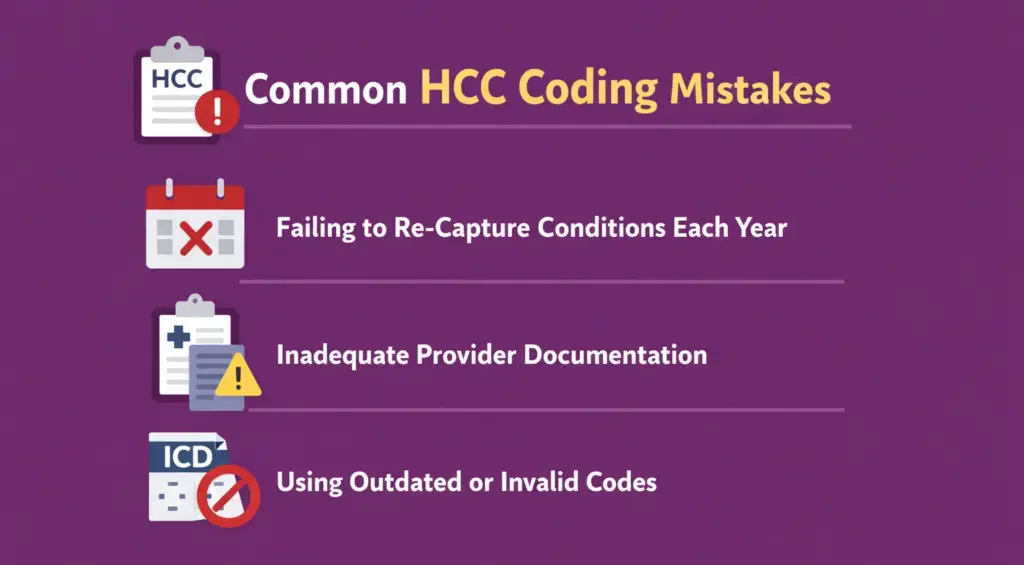
Common HCC Coding Mistakes
Even experienced practices lose revenue and create compliance risk when HCC rules are misunderstood or applied inconsistently. Most HCC errors come from documentation gaps, outdated coding practices, or failure to follow CMS reporting requirements.
Failing to Re-Capture Conditions Each Year
HCCs reset every calendar year, which means chronic conditions must be documented and coded again during a face-to-face encounter. If a provider does not re-report a condition like diabetes or heart failure, CMS assumes the patient no longer has it, even if it is still being treated. This instantly lowers the patient’s RAF score and reduces reimbursement.
Inadequate Provider Documentation
HCC codes must be supported by MEAT criteria, which means the provider must show that the condition was Monitored, Evaluated, Assessed, or Treated. Listing a diagnosis without clinical context, treatment plans, or ongoing management does not meet CMS standards and can fail audits.
Using Outdated or Invalid Codes
CMS updates the HCC model every year, adding, removing, or changing how ICD-10 codes map to risk categories. Using outdated code mappings can result in diagnoses that no longer count toward risk adjustment, causing silent revenue loss and compliance exposure.
Best Practices for Accurate HCC Coding
Accurate HCC coding requires a combination of strong documentation, proper workflows, and ongoing quality checks. When these elements work together, providers protect both revenue and compliance.
Documenting Conditions at Every Visit
Chronic conditions should be documented during face-to-face visits at least once per year. Providers should not rely on past records or problem lists alone, because only actively documented conditions count for HCC reporting.
Linking Diagnoses to Active Management
Every HCC-eligible condition must show evidence of active care. This includes medications, tests, referrals, monitoring, or treatment plans. When diagnoses are clearly tied to clinical action, they meet MEAT requirements and stand up during audits.
Performing Regular HCC Audits
Routine HCC audits help identify missed diagnoses, documentation gaps, and outdated codes before they lead to revenue loss or compliance issues. These audits ensure that every patient’s risk profile reflects their true medical complexity.
Struggling with missed HCCs, undercoding, or documentation gaps? Speak with a Medical Billing Expert to identify hidden revenue opportunities in your risk adjustment process.
How HCC Impacts Medical Billing and Revenue Cycle
HCC coding directly influences how much Medicare pays for your patients and how predictable your revenue becomes. When chronic conditions are fully captured, your practice receives reimbursement that aligns with the true cost of care, improving cash flow and financial stability.
Inaccurate or incomplete HCC reporting, however, leads to underpayments, higher denial risk, and greater audit exposure. Strong HCC workflows integrated into your billing and coding process ensure that claims, risk scores, and compliance requirements all work together to support long-term revenue growth.
Conclusion
HCC coding plays a powerful role in how Medicare measures patient risk, calculates reimbursements, and evaluates compliance. When chronic conditions are accurately documented and coded each year, providers receive fair compensation for the complexity of care they deliver while protecting themselves from audit exposure. However, missed diagnoses, weak documentation, or outdated codes can silently drain revenue and increase compliance risk.
FAQs
HCC stands for Hierarchical Condition Category, a CMS risk-adjustment model that uses diagnosis codes to determine how sick a patient is and how much Medicare should pay for their care.
Yes, HCCs reset annually, which means chronic conditions must be documented and coded during a face-to-face visit each year to continue counting toward risk adjustment.
If a condition is not captured, the patient’s risk score drops, leading to lower Medicare reimbursements and inaccurate representation of their medical complexity.
Practices improve HCC accuracy by documenting conditions at every visit, linking diagnoses to active treatment, keeping CAQH and records updated, and performing regular HCC audits.